What If GTA 6 Came Out in the 1990s
GTA 6, but on a PlayStation 1 Picture 1998. The PlayStation owns the living room, the N64 is putting up a fight, and PC gamers are deep into Half-Life and StarCraft. Now imagine Rockstar walks on stage and announces Grand Theft Auto VI.
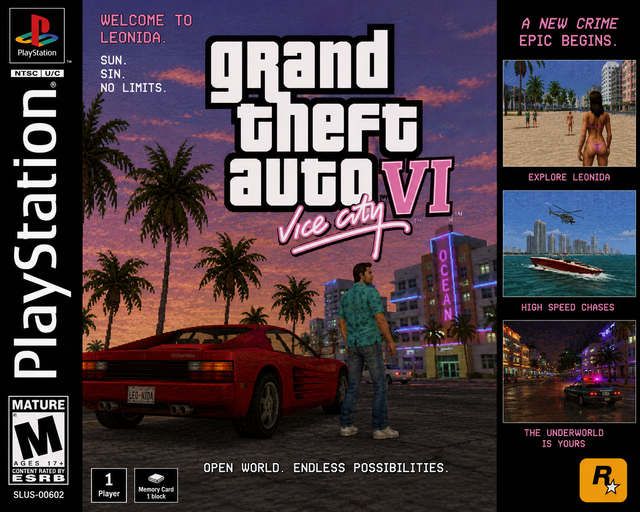
Game Title
GTA 6, but on a PlayStation 1
Picture 1998. The PlayStation owns the living room, the N64 is putting up a fight, and PC gamers are
deep into Half-Life and StarCraft. Now imagine Rockstar walks on stage and announces Grand Theft Auto
VI.
Obviously it never happened — but it's a fun thing to chew on. Strip GTA 6 down to what a late-'90s
console could actually run, and what's left?
Vice City, shrunk in the wash
The real GTA 6 hands you Vice City and the whole state of Leonida to roam. A 1998 version would've been
a fraction of that, because there was nowhere to put it. The PS1 had about 2 MB of RAM and a
single-speed CD drive doing the heavy lifting.
So expect a Vice City you could basically memorize: a handful of blocks, a loading screen every time you
crossed a bridge, draw distance that swallowed buildings a street ahead of you, and maybe a dozen cars
on screen before the framerate begged for mercy. Big for 1998. Adorable by today's standards.
Top-down, or a wobbly first stab at 3D?
The original Grand Theft Auto (1997) and GTA 2 (1999) were both isometric — you looked down on the chaos
from above. A '90s GTA 6 lands one of two ways.
The safe bet is a souped-up version of that top-down formula: sharper sprites, bigger maps, smarter
cops, and — the real upgrade — actual radio stations and voice clips instead of MIDI loops. Honestly,
this is probably what it would've been.
The wild bet is Rockstar gambling on early 3D, around the same time they were cooking up what became GTA
III in 2001. You'd get blocky models, muddy textures, cars that handled like shopping carts on ice, and
pedestrians with the AI of traffic cones. Rough — but people would've lost their minds over it anyway.
A story told in text boxes
Modern GTA leans on motion capture, facial animation, and tens of thousands of voiced lines. None of
that fits on a CD-ROM in 1998. The story would arrive the old-fashioned way: a text briefing before each
job, a short cutscene if you were lucky, and characters who said their piece and got out of the way.
Lucia and Jason could still headline — you'd just get their personalities from mission text and a few
grainy radio mentions instead of a Hollywood-grade screenplay.
The radio would carry the whole thing
Here's the one area where '90s Rockstar wouldn't have to apologize for anything. Even on a tight audio
budget, they'd nail the vibe: cheesy Miami dance tracks, a classic-rock station, a talk-radio host
melting down on air, and fake ads that were funnier than they had any right to be. Compression would
limit how many songs you got, but atmosphere was always the point.
Multiplayer? Don't hold your breath
Online gaming in 1998 was a dial-up modem screaming at you for two minutes before dropping the
connection. A GTA 6 from this era is single-player, full stop. If multiplayer showed up at all, it'd be
a LAN party special — a few friends, split between racing or a bare-bones deathmatch. GTA Online this is
not.
How do you even fit it?
Today's GTA 6 is rumored to push past 100 GB. The '90s cut would've squeezed onto one CD (650–700 MB),
maybe spilling onto a second disc if Rockstar got ambitious — cue the "please insert Disc 2" prompt
mid-mission. Everything would be compressed to within an inch of its life, and the world detail would
pay the price.
Would it have actually been a hit?
Yeah, easily. You don't judge a 1998 game against 2025 — you judge it against Driver and Need for Speed
III. An open city you could just… drive around in, steal anything with wheels, take jobs, and cause
problems, all with a soundtrack that slapped? That would've felt like something beamed in from the
future.
It'd be smaller, uglier, and held together with duct tape compared to the real thing. But the heart of
it — a living city that lets you off the leash — was always the part that mattered. And in the '90s,
that idea alone would've been enough.